Body Composition Measurements: What to Track Besides Scale Weight
How to combine body weight, waist measurements, progress photos, performance, and body-fat estimates without overreacting to noise.
Scale weight is useful, but it is incomplete. A lifter can gain weight while improving body composition, lose weight while losing muscle, or stay the same weight while waist size changes. Body composition tracking works best when several simple measures are interpreted together.
The goal is not to chase perfect accuracy. The goal is to see the direction clearly enough to make better decisions.
Use Average Body Weight
Daily weight moves because of water, salt, carbohydrate intake, bowel contents, soreness, and menstrual cycle changes. A single weigh-in is noisy. A 7-day average is more useful. Compare averages week to week rather than reacting to one number.
If weight jumps after a high-sodium dinner, that is probably water. If the weekly average rises for three weeks in a gaining phase, that is a real trend. Context turns numbers into decisions.
Measure the Waist Consistently
Waist measurement is one of the most practical body-composition signals. Use the same location, same tape tension, same time of day, and same posture. Common sites are at the navel or the narrowest point of the waist. Pick one and keep it consistent.
If weight is stable and waist is decreasing, body composition may be improving. If weight is rising quickly and waist is rising faster than planned, the calorie surplus may be too large.
Use Photos Carefully
Progress photos are useful only when lighting, pose, distance, and timing are consistent. Take front, side, and back photos under similar conditions every 2 to 4 weeks. Do not compare a post-workout pump photo with a tired morning photo and treat the difference as progress.
Photos can be emotionally loaded, so use them as one data point. They should support decisions, not punish the client.
Body-Fat Estimates Are Estimates
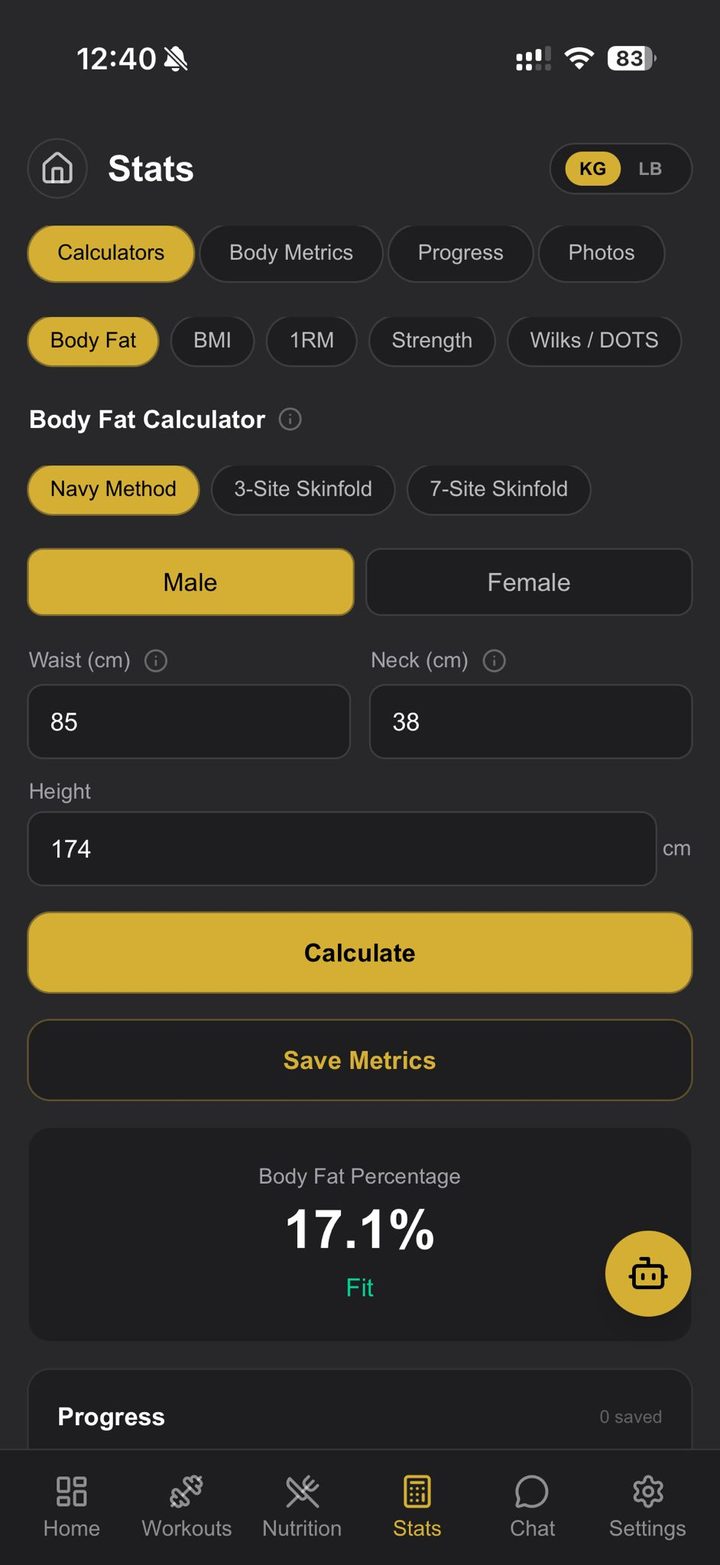
Calipers, circumference formulas, smart scales, and camera-based estimates all have error. They can still be useful if the method is repeatable. Treat the number as a trend, not an identity. A change from 24 percent to 21 percent over several months may be meaningful even if the exact values are imperfect.
In Carbyne Lab, body metrics sit next to workout logs. That matters because the goal is not only to change appearance. It is to improve or preserve performance while body composition changes.
What to Review Each Month
- Average body weight trend.
- Waist measurement trend.
- Progress photos under similar conditions.
- Strength or training-volume trend.
- Energy, hunger, and recovery notes.
If all signals point in the same direction, the decision is easy. If they disagree, keep collecting data for another one or two weeks before making a large change.
Sources and Further Reading
Author
Brian Chang
Brian Chang is an IFPA Master Personal Trainer who writes and reviews Carbyne Lab's fitness education, with a focus on strength training, exercise technique, nutrition tracking, and practical coaching decisions.
View author profileReviewed
Brian Chang, IFPA Master Personal Trainer
Maintained under the site's editorial standards. Last updated June 28, 2026.
View reviewer profileReady to train smarter?
Try Carbyne Lab free — AI-powered workout tracking, nutrition logging, and program generation.
Get Started FreeMore from the Blog
Progress Photos Guide: How to Make Visual Tracking Useful and Private
How to take consistent progress photos, interpret them with measurements and performance, and avoid turning visual tracking into a daily stressor.
Workout Log Review Checklist: What a Coach Looks For
A practical checklist for reviewing workout logs: consistency, progression, exercise balance, effort, recovery, and notes that explain plateaus.
Protein Intake for Strength Training: How Much Is Enough?
A practical protein guide for lifters: daily targets, meal distribution, calorie deficits, plant proteins, and when higher intake helps.
Beginner Strength Program: What the First 12 Weeks Should Prioritize
A coach's framework for the first 12 weeks of strength training: movement practice, simple progression, recovery, and when to add complexity.